Pulse compression gratings for demanding high-power ultrashort pulse laser applications
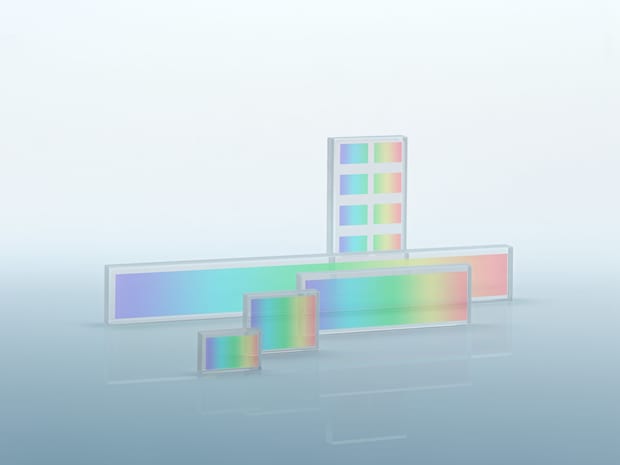
Diffraction gratings are one of the key elements in CPA (chirped pulse amplification) setups of femtosecond lasers. The diffraction efficiency of the pulse compression gratings (PCGs) has a huge impact on your laser performances in terms of efficiency.
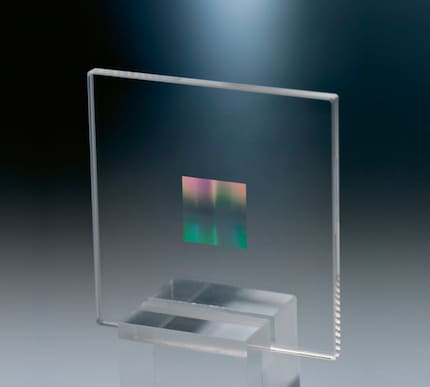
Jenoptik´s dielectric e²® pulse compression gratings are highly efficient and durable under high laser power densities. They are made of high-purity fused silica and are thus well suited for a broad wavelength range – in transmission or reflection.
Whether reflective or transmission pulse compression gratings, our PCGs offer high diffraction efficiency, low wavefront errors, and a high laser-induced damage threshold. Thanks to their embedded grating structure the transmission e²®- PCGs are also protected from external mechanical damage and dust.
Jenoptik´s dielectric e²® pulse compression gratings are highly efficient and durable under high laser power densities. They are made of high-purity fused silica and are thus well suited for a broad wavelength range – in transmission or reflection.
Whether reflective or transmission pulse compression gratings, our PCGs offer high diffraction efficiency, low wavefront errors, and a high laser-induced damage threshold. Thanks to their embedded grating structure the transmission e²®- PCGs are also protected from external mechanical damage and dust.
Discover how our PCGs increase efficency, performance and reliablity for the following applications
- Laser pulse compression in chirped pulse amplifiers (CPA)
- Spectral beam combining of high-power laser for laser material processing
- Wavelength selection and bandwidth narrowing
- Spectral beam combining
Key facts to know about diffraction gratings
A diffraction grating’s performance is governed by a handful of inter‑related properties. Understanding which ones matter most for your application will help you choose (or design) the right grating.
Line density - the heart of the angular dispersion
The number of grooves per millimeter fixes the angles at which the various diffraction orders appear. A higher line density gives larger angular separation between wavelengths, which is great for spectrometers, but it also makes the grating harder to fabricate and can increase sensitivity to alignment errors.
Size and homogenity - the secret to high resolution
Large gratings (tens of centimeters to a meter) let you illuminate many more grooves, boosting spectral resolution. The challenge is keeping the groove spacing, groove width and groove height homogen across the whole surface; any variation degrades the wave‑front quality of the diffracted beam.
Diffraction efficiency – how much light you actually get
Efficiency is the fraction of incident power that ends up in the desired order. It depends on groove shape, wavelength, angle of incidence and, for reflective gratings, polarization. Transmission gratings made from low‑absorption dielectrics can rival or even surpass reflective gratings because they avoid metal losses.
Polarization dependence
Pulse compression gratings often show strong differences between s‑ and p‑polarized light.
Damage threshold - crucial for pulsed-laser work
A grating must survive the peak fluence of the laser. Low‑absorption, all‑dielectric gratings have the highest thresholds.
Thermal properties – stability under heat
Temperature changes alter the groove spacing through thermal expansion, shifting the diffraction angles. Materials with low thermal‑expansion coefficients are preferred in high‑power or temperature‑varying environments (e.g., spectral beam‑combining).
Key Advantages
Highly efficient
Maximum diffraction efficiency, close to 100%, to enhances the performance of your laser
High line densities
(up to 5000 ln/mm), enable compact product design and high pulse compression
High dispersion
Better spectral resolution allowing high-precision and sensitivity
High damage threshold
Encapsulated fused silica gratings with both sides excellent dielectric AR coating system (for transmission)
Customer-specific design
Choose dimension up to 140 mm square and line densities up to 5000 lines/mm
Check out our reflective PCGs for high-power and high-dispersion pulse compression!
Contact us directly to discuss your requirements on substrate geometries, like line density or gratings area. We are happy to find the right fit for your demanding application.
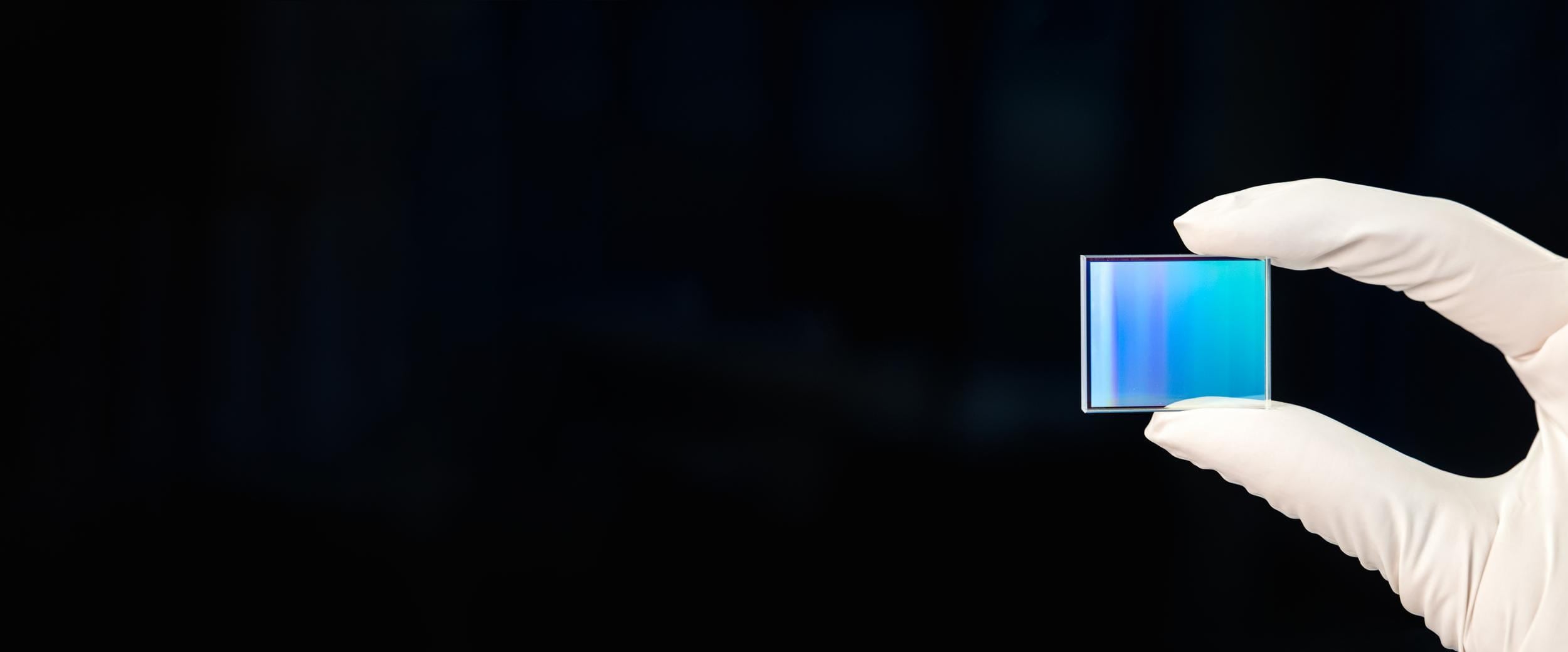
High-quality manufacturing for customized gratings
Jenoptik offers customized pulse compression grating solutions that are precisely engineered to meet each customer's specific requirements. With a variety of options available, such as different grating periods, sizes and coatings, customers can rely on Jenoptik to provide a bespoke solution that meets their exact requirements.Our state-of-the-art manufacturing facility in Dresden, equipped with the latest technology and equipment, enables us to produce high-quality, customized gratings with unparalleled precision and accuracy.
Benefit from the newest facility features
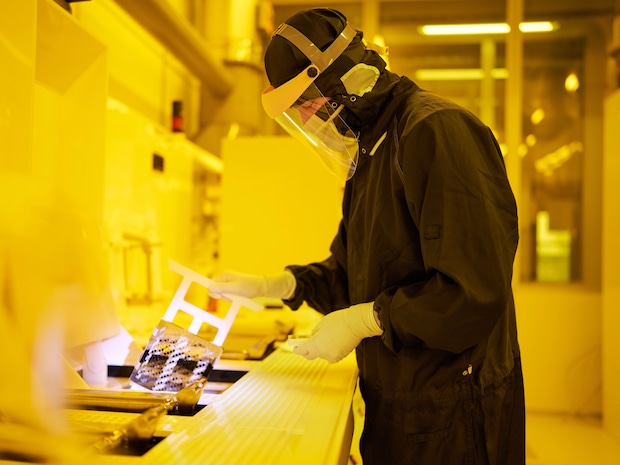
Cleanroom environment: The fab is equipped with a cleanroom environment that ensures the highest level of cleanliness and quality control during the manufacturing process.
Advanced lithography tools: Jenoptik has installed advanced lithography tools, including electron beam lithography to enable the production of high-precision gratings with complex patterns.
Advanced lithography tools: Jenoptik has installed advanced lithography tools, including electron beam lithography to enable the production of high-precision gratings with complex patterns.

High-precision etching and coating tools: The fab is equipped with high-precision etching and coating tools, including reactive ion etching, sputtering and Plasma-Ion-Assisted deposition systems, to enable the production of high-quality gratings with precise grating profiles and coatings.
Automated manufacturing lines: Jenoptik has implemented automated manufacturing lines to ensure high throughput and consistent quality, while minimizing the risk of human error.
Automated manufacturing lines: Jenoptik has implemented automated manufacturing lines to ensure high throughput and consistent quality, while minimizing the risk of human error.
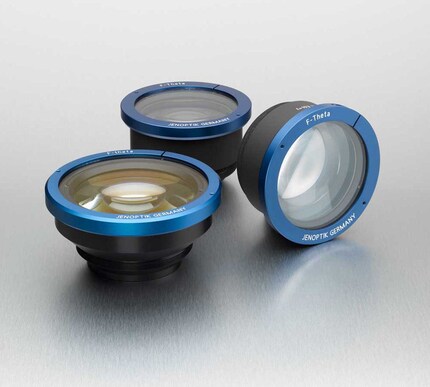
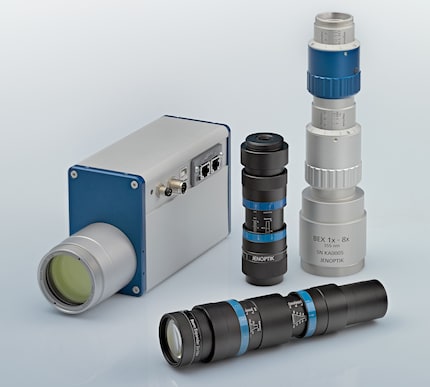
Take advantage of our broad product portfolio to obtain a suitable complete solution from a single source
Are you ready to take your optical systems to the next level?